Google Ad Grants for Churches: The Complete Guide to Eligibility, Restrictions, and Strategy
Churches represent one of the largest segments of Google Ad Grant users, and for good reason: "churches near me" is one of the highest-volume local searches in the nonprofit space. A well-managed church Grant account can drive hundreds of visitors, event attendees, and community members every month.
But churches also face unique restrictions. Google limits advertising that promotes religious proselytizing, which means your keyword strategy and ad copy need a specific approach. This guide covers everything churches need to know about eligibility, compliance, and campaign strategy.
Key Takeaways - Churches with 501(c)(3) status (or equivalent) are eligible for Google Ad Grants - Content must focus on community services, not religious conversion - "Felt-need" keywords (grief support, marriage counseling, youth programs) are the highest performers - Seasonal campaigns (Easter, Christmas, VBS) drive significant traffic - Local targeting and Google Maps (via PMax) are essential for churches
Eligibility
Who Qualifies
Churches qualify for Google Ad Grants if they meet the standard eligibility requirements:
United States: Must hold 501(c)(3) tax-exempt status with the IRS. Most established churches have this. Newer churches that haven't yet received their determination letter can apply after receiving it.
United Kingdom: Must be registered with the Charity Commission (England and Wales), OSCR (Scotland), or CCNI (Northern Ireland).
Australia: Must be registered with the ACNC (Australian Charities and Not-for-profits Commission).
Other countries: Must hold equivalent charitable status recognized in Google for Nonprofits' 50+ eligible countries.
Who Doesn't Qualify
- Churches that haven't completed their charitable registration
- Religious organizations primarily engaged in political activity
- Individual clergy or ministries without organizational charitable status
The Content Restriction
Google's policy states that Ad Grants cannot be used for ads that primarily promote religious proselytizing. This doesn't mean you can't mention faith. It means your ads should focus on what you offer the community rather than on converting people to your religion.
What works:
- "Free marriage counseling at [Church Name]"
- "Youth basketball league, Saturdays at [Church]"
- "Grief support group: you're not alone"
- "Community food pantry, open Tuesdays"
- "Vacation Bible School: register your kids"
What to avoid:
- "Accept Jesus as your savior today"
- "Find salvation at [Church Name]"
- Ads whose sole purpose is doctrinal teaching or evangelism
The practical approach: focus your Grant campaigns on the felt needs of people in your community, and let your church's programs and hospitality handle the spiritual journey.
The Felt-Need Keyword Strategy
"Felt-need" keywords target the real-life challenges that bring people to search for help, challenges your church is uniquely positioned to address:
High-Performing Keyword Categories
| Category | Example Keywords | Why They Work |
|---|---|---|
| Relationship support | "marriage counseling near me," "couples retreat [city]," "relationship help" | People seek help privately via search first |
| Grief and loss | "grief support group [city]," "bereavement counseling," "coping with loss" | High-intent, deeply personal searches |
| Youth and family | "youth group [city]," "after-school programs," "vacation bible school registration," "family activities [city]" | Parents search for safe, enriching programs for their kids |
| Community services | "food pantry near me," "free meals [city]," "clothing donation [city]," "community support services" | Service seekers and donors both search these terms |
| Recovery and addiction | "AA meetings near me," "celebrate recovery [city]," "addiction support group" | Churches host many recovery programs |
| Mental health | "anxiety support group [city]," "free counseling [city]," "mental health resources" | Growing demand, and churches often provide these services |
| Local discovery | "churches near me," "church in [neighborhood]," "Sunday service [city]" | The most searched church-related terms |
Keywords to Approach Carefully
- Generic single-word religious terms ("prayer," "faith," "Bible"): These are either blocked by keyword policies (single-word) or too broad for good CTR
- Denominational terms ("Baptist church," "Methodist church"): Can work as long as the landing page is welcoming and informative, not purely doctrinal
- Theological search terms ("what does the Bible say about..."): Can work for educational content, but ensure landing pages are service-oriented, not proselytizing
Campaign Structure for Churches
Recommended Campaigns
Campaign 1: Brand Keywords: Church name, abbreviations, "church on [street name]" Purpose: Capture people specifically looking for your church
Campaign 2: Local Discovery Keywords: "churches near me," "church in [city]," "[denomination] church [city]," "Sunday service [city]" Purpose: Reach people exploring church options in your area
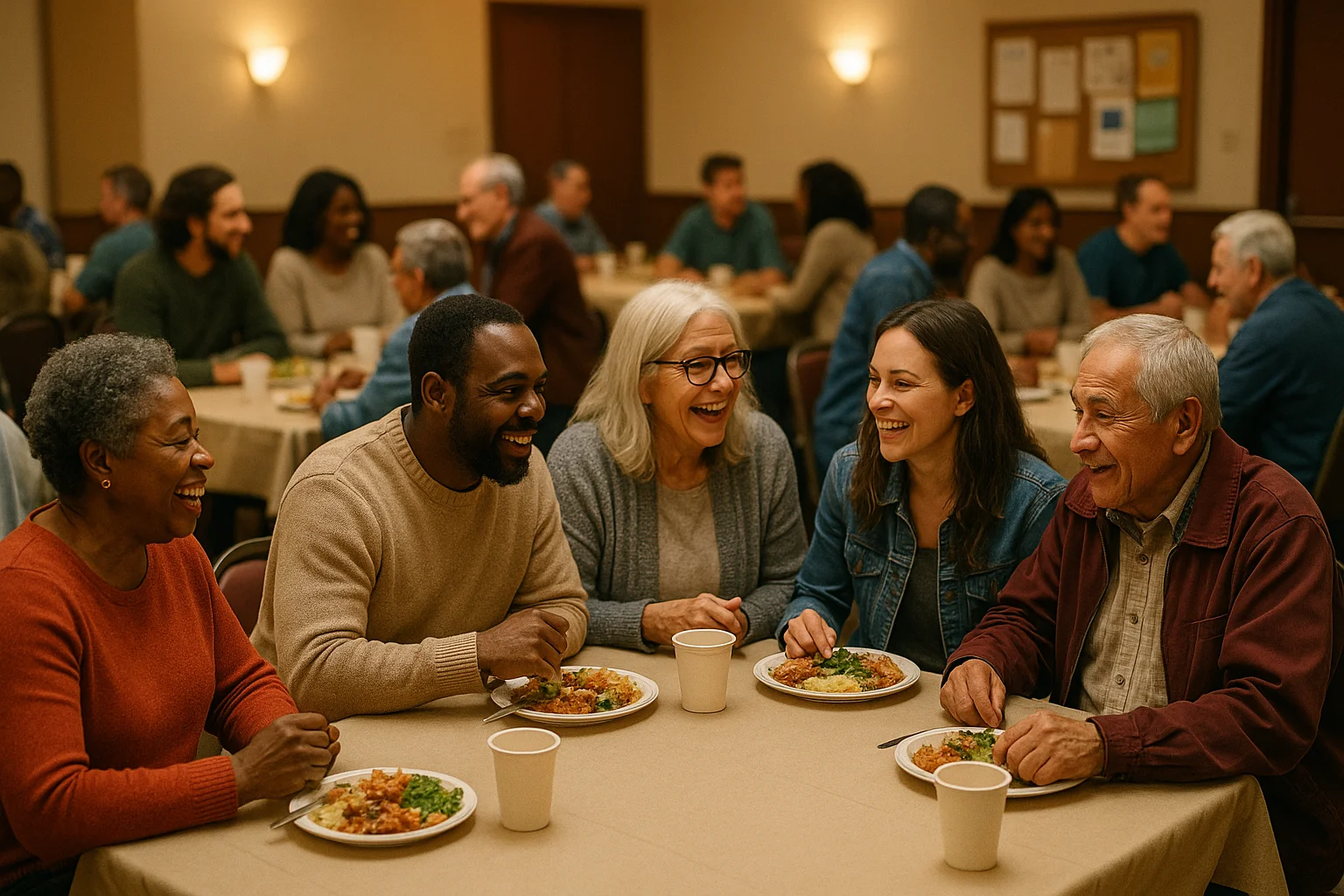
Campaign 3: Community Services Keywords: "food pantry [city]," "free meals," "clothing donations," "community support" Purpose: Connect service seekers with your outreach programs
Campaign 4: Programs and Events Keywords: "youth group [city]," "VBS registration," "marriage retreat," "community event [city]" Purpose: Drive registrations for specific programs
Campaign 5: Support and Counseling Keywords: "grief support group," "marriage counseling near me," "addiction recovery [city]" Purpose: Reach people in crisis who need the support your church offers
Campaign 6: PMax Purpose: Google Maps visibility for local discovery, especially for mobile searchers
Seasonal Campaign Calendar
Churches have natural seasonal peaks that align with search behavior:
| Season | Campaign Focus | Key Keywords |
|---|---|---|
| January | New Year programs, small groups | "small group [city]," "Bible study near me," "new year community events" |
| March-April | Easter services | "Easter service [city]," "Easter events for kids," "Good Friday service" |
| May-June | VBS registration | "vacation bible school [city]," "VBS registration," "summer kids programs" |
| August-September | Fall programs, back to school | "youth group [city]," "after-school program," "fall small groups" |
| October-November | Community events, Thanksgiving | "fall festival [city]," "trunk or treat," "Thanksgiving volunteer" |
| December | Christmas services | "Christmas Eve service [city]," "Christmas events for families," "holiday church service" |
Build these campaigns in advance and activate them 4-6 weeks before each season. See our campaign calendar guide.
Ad Copy Tips for Churches
Do:
- Lead with what you offer: "Free Marriage Counseling: Thursdays at 7pm"
- Include practical details: hours, location, "no appointment needed"
- Address the felt need: "Going Through Grief? You're Not Alone"
- Mention welcoming language: "All Are Welcome," "Casual Dress, Come As You Are"
Don't:
- Lead with doctrinal statements
- Use insider church jargon ("fellowship," "sanctification") in ad headlines
- Push for religious conversion in the ad copy
- Assume the searcher is already a believer
For general ad copy guidance, see our high-CTR ad copy guide.
Local Targeting for Churches
Most churches serve a geographic community. Configure your targeting accordingly:
- Radius targeting: 5-15 mile radius around your physical location (adjust based on urban vs. rural)
- "People in" setting: Target people physically in your area, not just people interested in it
- Multiple campus targeting: If your church has multiple locations, consider separate campaigns for each with location-specific targeting
Link your Google Business Profile for Maps visibility, and ensure your hours, address, and service times are accurate. See our geographic targeting guide.
Maximize Your Church's Grant with GrantMax
GrantMax audits your church's Grant account against all compliance requirements and best practices, identifying exactly what to improve for better performance.
Audit My Church's Grant - Free
Prefer to hand it off to an expert? Our Google Ad Grant management services have experience with church accounts and the unique restrictions that apply. Explore Grant Services
Frequently Asked Questions
Can our church advertise our Sunday services? Yes, as long as the ad focuses on the community benefit (welcoming environment, children's programs, music) rather than purely on religious conversion messaging.
Our church runs a food pantry and a counseling center. Can we advertise those? Absolutely. Community service programs are ideal for Grant advertising. These are the campaigns most likely to perform well and stay within Google's content guidelines.
We're a small church with limited web content. Can we still use the Grant? Yes, but you'll need landing pages that match your keywords. Start with your brand campaign and local discovery, then build out content (program pages, event pages, blog posts) to enable more campaigns. Even 3-4 campaigns can generate meaningful traffic.
Does the "no proselytizing" rule mean we can't mention God or faith at all? No. Your website and landing pages can reflect your faith. The restriction applies to the ad copy and the primary purpose of the ad. An ad for "Community Grief Support Group at [Church Name]" is fine even if the program includes prayer or faith-based elements. An ad whose sole message is "Turn to Jesus Today" is not.
Does this guide apply to churches in all countries? Yes. The eligibility criteria, content restrictions, and strategies apply to churches globally. The specific charitable registration varies by country, but the Grant program rules are the same.
Key Takeaways
- Churches with 501(c)(3) or equivalent status are eligible for the $10,000/month Grant
- Content restrictions apply: focus on community services and felt needs, not proselytizing
- Felt-need keywords (grief, marriage, youth, recovery, community services) are the strongest performers
- Seasonal campaigns (Easter, VBS, Christmas) drive major traffic peaks
- Local targeting and Google Maps (via PMax) are essential for church accounts
- Ad copy should lead with what you offer, not with doctrinal statements
- 6 recommended campaigns: brand, local discovery, community services, programs, support/counseling, PMax
Published: March 2026 | Last Updated: March 2026 | Author: GrantMax Category: Nonprofit Verticals | Tags: Verticals, Churches