Google Ad Grants for Faith-Based Organizations: Eligibility, Restrictions, and What Actually Works
Faith-based organizations are among the most active nonprofits in communities around the world, providing food assistance, counseling, grief support, youth programs, and disaster relief. Many of them qualify for Google Ad Grants, the program that gives eligible nonprofits up to $10,000 USD per month in free Google Search advertising. But eligibility for faith-based organizations is more nuanced than for secular nonprofits, and the content restrictions that apply to religious advertising on Google require a specific strategic approach. This guide covers everything you need to know: who qualifies, what Google does and does not allow, and the campaign strategies that consistently produce results for faith-based nonprofits.
Key Takeaways - Most faith-based 501(c)(3) organizations (and their international equivalents) qualify for Google Ad Grants, but houses of worship face specific eligibility questions. - Google does not allow proselytizing or devotional content in Grant-funded ads. - The most effective strategy for faith-based organizations focuses on "felt-need" keywords: searches people make when they need help, not when they are looking for a church. - Local targeting and service-based campaigns consistently outperform purely mission-driven messaging.
Do Faith-Based Organizations Qualify for Google Ad Grants?
The short answer is: often yes, but it depends on how your organization is structured and what activities it primarily conducts.
Google for Nonprofits (the umbrella program that includes Ad Grants) is open to nonprofits that hold recognized charitable status in their country. In the United States, this means 501(c)(3) status issued by the IRS. In the United Kingdom, this means registration with the Charity Commission (England and Wales), OSCR (Scotland), or CCNI (Northern Ireland). In Australia, it means registration with the Australian Charities and Not-for-profits Commission (ACNC). In Canada, it means registered charity status with the Canada Revenue Agency. Google for Nonprofits operates in 50+ countries, each with its own equivalents.
Beyond charitable registration, Google explicitly excludes certain types of organizations regardless of their legal status. The relevant exclusions for faith-based organizations are:
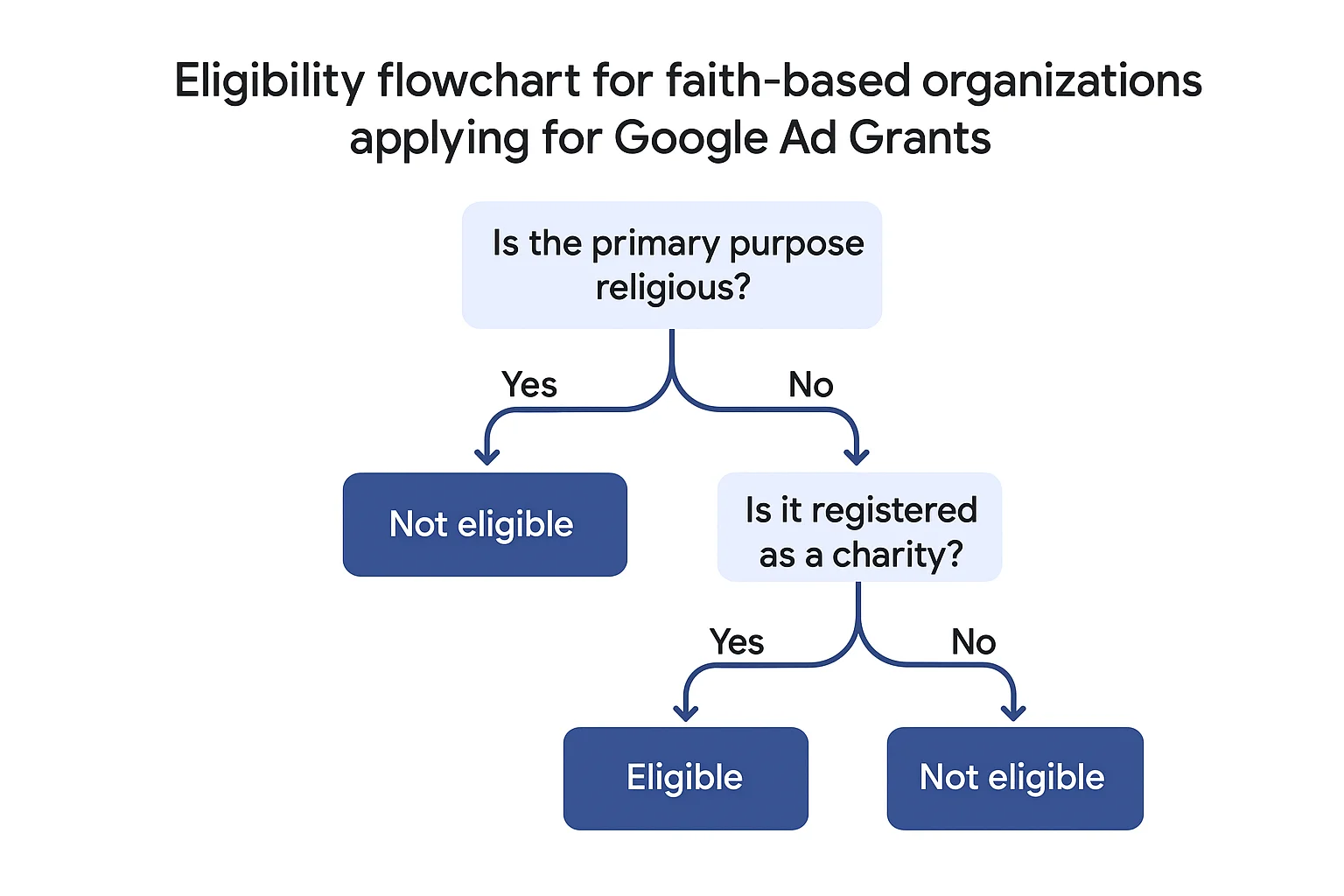
- Churches, synagogues, mosques, and other houses of worship that do not have a separately registered charitable entity are generally not eligible. A church that is a 501(c)(3) but whose primary mission is religious worship and practice may face rejection.
- Organizations whose primary purpose is religious activity (such as a ministry whose main output is sermons, devotional content, or sacraments) may not qualify even if they have charitable status.
- Faith-based organizations that conduct substantial public benefit programs (food banks, homeless shelters, counseling services, disaster relief, addiction recovery programs) are typically eligible, particularly if those programs are the primary activity of the organization.
Important: The eligibility decision often comes down to whether your organization's primary purpose is religious practice or community service. Many faith-based organizations successfully qualify by demonstrating that their primary outputs are measurable public benefit programs, with religious activity as a secondary or integrated component.
The Charitable Arm Strategy
If your house of worship does not qualify directly, a common and legitimate approach is to apply through a separately registered charitable entity. Many churches, mosques, synagogues, and temples operate a nonprofit arm (a food pantry, a counseling center, or a community development organization) that holds its own charitable registration and genuinely operates independently.
This entity can apply for Google Ad Grants in its own right, advertising its community services without representing the parent religious body. The Grant cannot then be used to promote religious services or recruit congregation members. It can only be used to promote the charitable entity's specific programs.
For a detailed breakdown of eligibility criteria, including international equivalents and edge cases, see our complete guide: Is your nonprofit eligible for Google Ad Grants?
Google's Content Policies for Faith-Based Advertising
This is where many faith-based organizations run into unexpected friction. Even if your organization qualifies, Google Ad Grants come with content restrictions that shape what you can and cannot advertise.
What Google Does Not Allow
Google's advertising policies prohibit several categories of content that are common in faith-based marketing:
- Proselytizing and conversion-focused content: Ads designed to recruit people to a religion, convert people from one faith to another, or promote religious beliefs as superior to others are not permitted. This includes headlines like "Find the truth in Christ" or "Islam is the path to salvation."
- Devotional content as the primary offering: Ads promoting sermons, prayer meetings, worship services, Bible studies, or similar devotional activities as the main call to action do not meet Google's content standards for Grant-funded campaigns. This is perhaps the most significant restriction for churches and similar organizations.
- Content that demeans other beliefs: Any content that criticizes, mocks, or disparages other religions or belief systems violates Google's policies and will be disapproved.
- Miracle claims: Ads making supernatural claims (healing miracles, divine intervention as a guaranteed outcome) are likely to face disapproval for making unverifiable claims.
What Google Does Allow
The content restrictions leave significant room for effective faith-based advertising, particularly around the community services and support programs that many religious organizations provide:
- Awareness of community services: Advertising food banks, clothing drives, emergency financial assistance, and similar programs is fully permitted and highly effective.
- Mental health and counseling services: Many faith-based organizations offer pastoral counseling, grief support groups, addiction recovery programs, and marriage counseling. These can be advertised openly, with or without explicit religious framing.
- Educational programs: Parochial schools (if they have a separate charitable entity), tutoring programs, literacy classes, and vocational training can be promoted through Grant-funded campaigns.
- Community events with clear public benefit: Events like community dinners, holiday assistance programs, and youth sports leagues are eligible topics for ads.
- Volunteer recruitment: Recruiting volunteers for community service activities is a strong use of Grant-funded advertising.
- Crisis support and helplines: Organizations offering crisis support, domestic violence assistance, or suicide prevention can and should use Grant-funded ads to reach people searching for help.
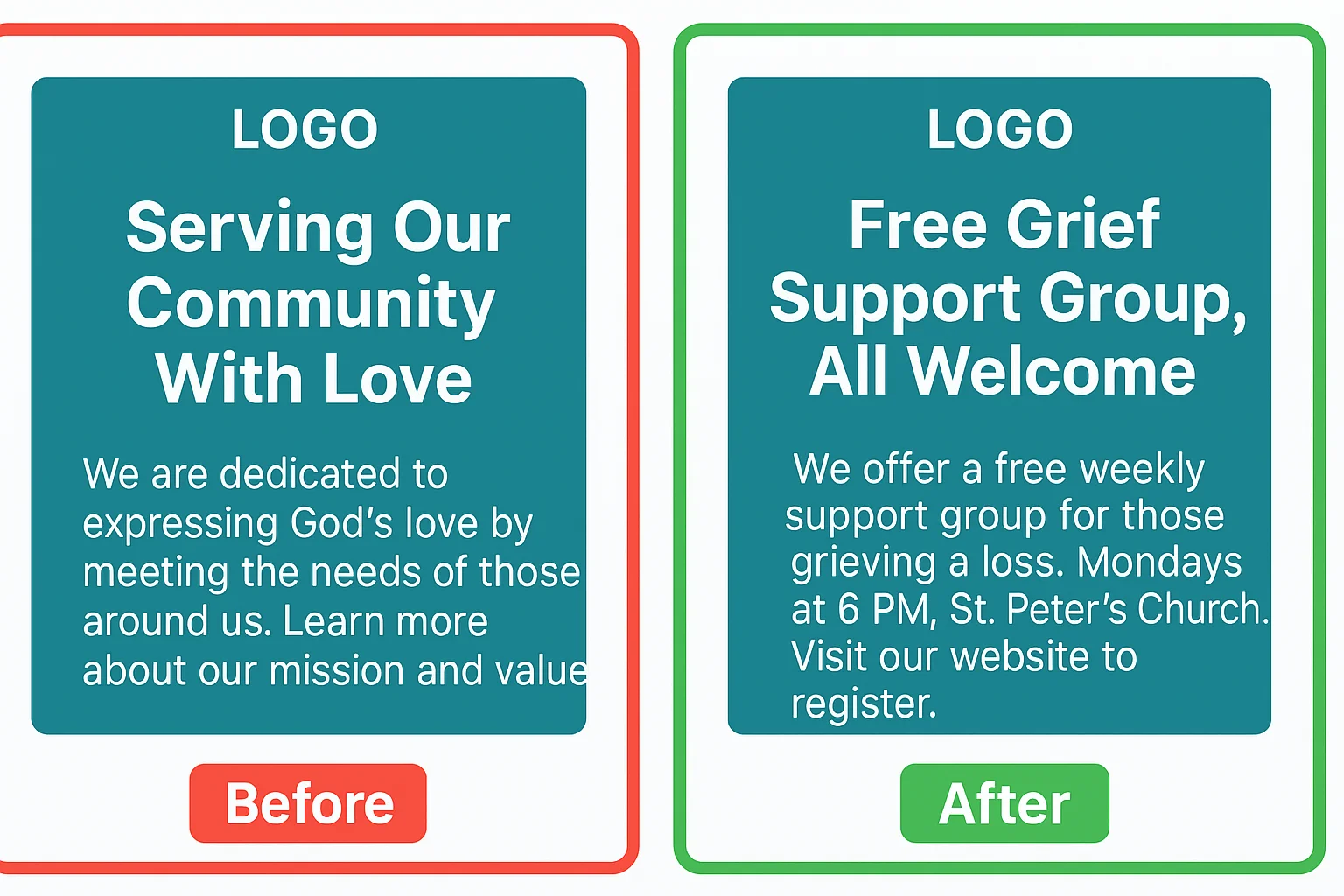
Pro Tip: Google distinguishes between advertising a service (allowed) and advertising a faith (restricted). An ad that says "Free grief support group, open to all" is permitted. An ad that says "Find healing through Christ. Join our grief ministry" blurs the line and may face disapproval. When in doubt, lead with the service, not the theology.
The Felt-Need Keyword Strategy
The most effective keyword strategy for faith-based Google Ad Grant accounts is built around what practitioners call felt-need keywords: search terms that people use when they are experiencing a problem and looking for help, rather than when they are searching for a church or religious organization.
This approach works for two reasons. First, it aligns with what Google's content policies allow. Second, it reaches people at a moment of genuine need, when the services your organization provides are most valuable to them.
Felt-Need Keyword Categories
The following categories represent high-value keyword opportunities for faith-based organizations:
| Keyword Category | Example Keywords | Relevant Services |
|---|---|---|
| Grief and loss | grief support near me, grief counseling group, bereavement support | Grief groups, pastoral counseling |
| Marriage and relationships | marriage counseling near me, couples therapy affordable, pre-marital counseling | Marriage counseling, family support |
| Mental health | anxiety support group, depression help near me, free mental health resources | Counseling services, support groups |
| Addiction and recovery | addiction recovery program near me, free drug rehab, sobriety support | Recovery programs, 12-step groups |
| Food assistance | food bank near me, free groceries near me, food pantry hours | Food pantry, community meals |
| Financial help | emergency financial assistance, help paying rent, utility bill assistance | Financial counseling, emergency aid |
| Youth programs | after school programs near me, free youth activities, summer camp free | Youth groups, summer programs |
| Domestic violence | domestic violence shelter near me, abuse support, safe house near me | Shelter, crisis support |
| Parenting support | parenting classes near me, family support services, single parent help | Family programs, parenting groups |
For a comprehensive guide to keyword research for Grant accounts, including how to use Google Keyword Planner to identify high-volume felt-need terms in your area, see our complete keyword strategy guide.
Geographic Targeting for Felt-Need Campaigns
Most felt-need searches are inherently local. Someone searching "food bank near me" or "grief support group" is looking for something accessible to them physically. This means geographic targeting is especially important for faith-based Grant campaigns.
For organizations that serve a specific community, target a radius around your physical location rather than a broad metropolitan area or state. A 10-15 mile radius is typically appropriate for urban and suburban organizations; rural organizations may need a wider radius to capture sufficient search volume.
One critical compliance note: Grant accounts must use proper geo-targeting and cannot be set to "All countries and territories." This is a common suspension trigger. See our guide on geo-targeting rules for Google Ad Grants for setup instructions.
Campaign Structure for Faith-Based Organizations
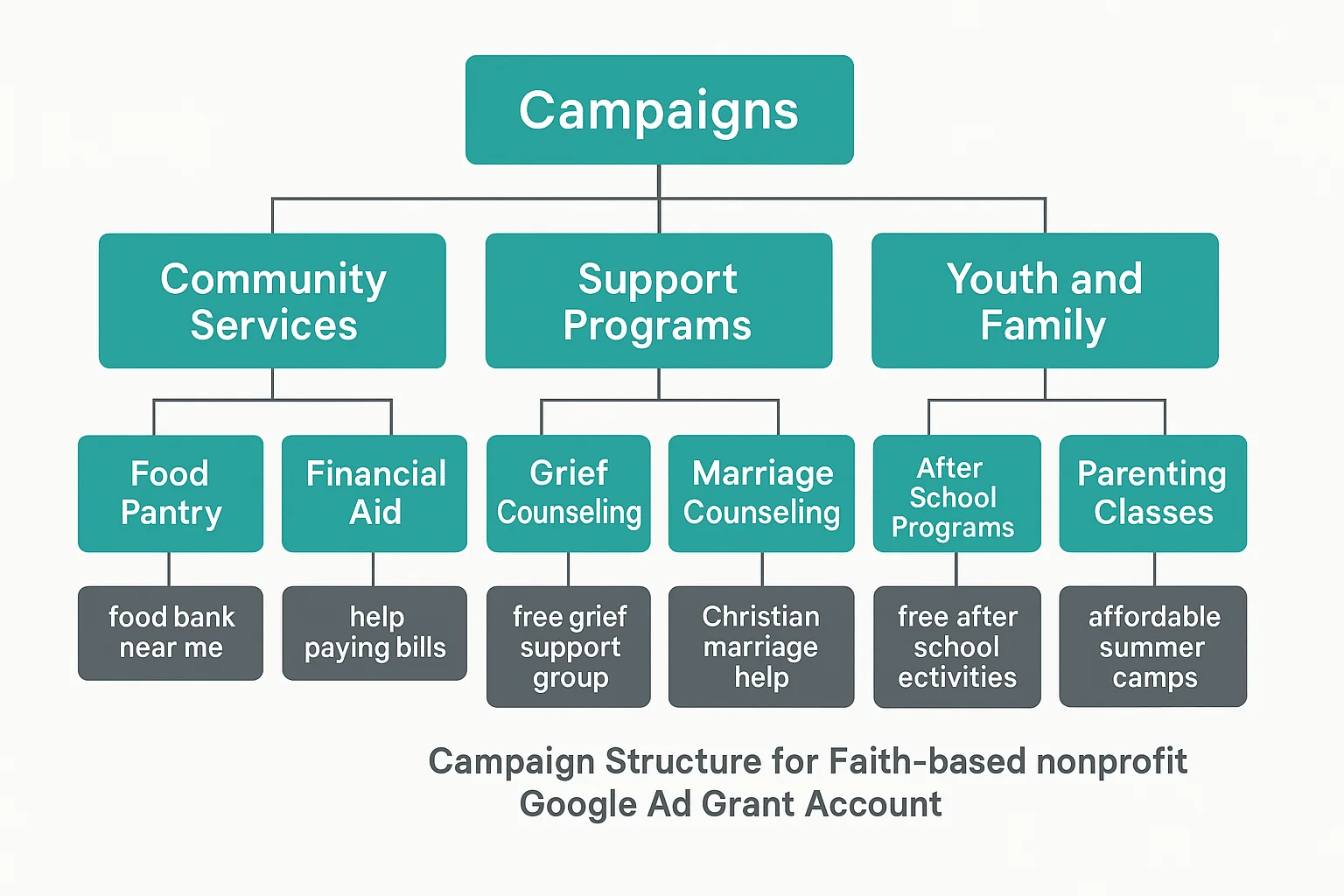
A well-structured Grant account for a faith-based organization typically separates campaigns by service category rather than by audience or season. This makes it easier to manage budgets, track performance by program, and maintain keyword relevance within each ad group.
Recommended Campaign Architecture
The following structure works well for a mid-sized faith-based organization with multiple service programs:
- Create one campaign per major service category (food assistance, counseling services, youth programs, volunteer recruitment, emergency aid, etc.)
- Within each campaign, create ad groups organized by specific service or search intent. A counseling campaign might have separate ad groups for grief counseling, marriage counseling, addiction recovery, and general mental health support.
- Set each campaign budget to $329 per day. This is the maximum daily budget allowed per campaign in a Grant account, and setting it at the maximum gives Google's algorithm the most flexibility to spend the full $10,000 USD monthly allowance.
- Use Maximize Conversions as your bid strategy once you have conversion tracking in place. This removes the old $2 CPC cap that applies to manual bidding and allows Google to bid competitively for your keywords.
- Add at least 8 sitelink assets pointing to your most relevant service pages: food pantry, counseling intake, volunteer sign-up, donation page, and similar.
Ad Copy Principles for Faith-Based Campaigns
Ad copy for faith-based Grant campaigns should lead with the service, not the organization's identity or religious affiliation. This is both a strategic and a policy requirement.
Effective ad copy for felt-need campaigns follows this structure:
- Headline 1: State the service or the outcome. "Free Grief Support Groups" or "Marriage Counseling Available Now."
- Headline 2: Add a qualifier that builds trust or reduces friction. "Open to All Faiths" or "No Referral Needed."
- Headline 3: Include location or availability. "Serving [City] Since 1985" or "Weekly Sessions Available."
- Descriptions: Expand on the service, mention what someone will get or experience, and include a clear call to action. "Our licensed counselors provide confidential grief support at no cost to you. Register online or call to learn more."
Notice what is absent from the above structure: any mention of the organization's religious identity, denomination, or theological position. This is intentional. People searching for grief support are looking for help, not a church. Once they arrive at your landing page, your organization's values and community can be presented naturally. The ad should meet them at their point of need.
For more detailed guidance on writing ad copy that drives clicks in Grant accounts, including templates and CTAs that work, see our guide to writing high-CTR nonprofit ad copy.
Seasonal Campaign Opportunities for Faith-Based Organizations
Faith-based organizations have a natural seasonal rhythm that creates predictable campaign opportunities throughout the year. Planning your Grant budget around these moments ensures you are visible when community need and search volume peak together.
| Season / Period | Campaign Focus | Keywords to Target |
|---|---|---|
| December / Holiday | Food drives, gift programs, holiday meals, toy collections | free christmas dinner, holiday food basket, toys for families in need |
| January / New Year | Life skills programs, financial counseling, new beginnings | free financial counseling, budgeting help near me, debt management |
| Easter / Spring | Community meals, family programs | free easter meal, spring community events, family activities |
| Summer | Youth programs, summer camps | free summer camp, after school programs summer, kids activities near me |
| Back to school | School supply drives, tutoring, financial aid for families | free school supplies near me, tutoring programs, back to school help |
| Thanksgiving | Food drives, volunteer recruitment, community meals | food bank volunteer, thanksgiving meal near me, donate food near me |
| Mental Health Awareness (May) | Counseling services, support groups, crisis resources | mental health support, free counseling near me, anxiety help |
| Domestic Violence Awareness (Oct) | Shelter and crisis services, legal support | domestic violence shelter, abuse help near me, safe house |
For each seasonal campaign, create the campaign in your account 4-6 weeks before the peak period so Google has time to learn the campaign before the high-traffic window arrives. Pause seasonal campaigns between peaks rather than deleting them. This preserves the performance history that Smart Bidding uses to optimize future spend.
Conversion Tracking for Faith-Based Nonprofits
Google Ad Grants require at least one meaningful conversion per month to maintain compliance, and the bid strategy requirement (Maximize Conversions or similar) means the algorithm needs conversion data to function effectively. For faith-based organizations, setting up the right conversions is worth spending time on.
Recommended Conversion Actions
The following conversion actions are both meaningful and trackable for faith-based Grant accounts:
- Program registration forms: Food pantry registration, counseling intake forms, volunteer sign-ups, and event registrations are all strong primary conversions.
- Contact form submissions: General inquiries or requests for more information count as meaningful conversions, particularly when tied to service-specific pages.
- Phone calls: If your organization receives calls for services, call tracking set up through Google Ads can count inbound calls from ads as conversions.
- Donation completions: If you accept online donations, completed donations are an excellent primary conversion to track.
- Email newsletter sign-ups: For organizations building a community list, newsletter sign-ups can be used as a secondary conversion.
What Google does not consider a meaningful conversion: simply visiting your homepage, spending time on a page, or other passive engagement metrics. For full compliance guidance, see our article on what counts as a meaningful conversion.
Common Mistakes Faith-Based Organizations Make with Google Ad Grants
Based on patterns observed across nonprofit Grant accounts, faith-based organizations tend to make a predictable set of mistakes. Knowing them in advance can save significant time and frustration.
Mistake 1: Bidding on Devotional Keywords
Keywords like "church near me," "Sunday service," "Bible study group," or "worship service" are tempting targets because they have search volume and seem relevant. The problem is threefold: they often trigger Google's sensitivity around religious content, they attract people who are already church members or seekers (not necessarily the service users you want to reach), and they often have low Quality Scores when paired with service-focused landing pages.
Save these keywords for organic search (where they are entirely appropriate) and focus your Grant budget on felt-need terms that align with the services you provide.
Mistake 2: Sending All Traffic to the Homepage
A common mistake across all nonprofit Grant accounts, but particularly visible in faith-based organizations, is sending every ad to the homepage. If someone clicks an ad about your food pantry and lands on a homepage that talks about your congregation's mission and theology, they are likely to leave immediately, hurting both your Quality Score and your conversion rate.
Every ad group should link to a dedicated landing page that matches the keyword intent exactly. If you are advertising grief counseling, link to a page that explains your grief counseling service, who it is for, how to register, and what someone can expect. See our guide on landing page optimization for Google Ad Grants for detailed guidance.
Mistake 3: Not Having Enough Keywords to Spend the Budget
Many faith-based Grant accounts are under-spending. This is not because the services are in low demand, but because the keyword list is too narrow. If you only have keywords for one or two programs, Google does not have enough options to spend the full $10,000 USD monthly budget.
The solution is to build keyword lists that cover every service your organization offers, plus educational content topics related to your cause areas, plus local awareness terms for your community. A well-structured account for a mid-sized faith-based nonprofit should have 200-400 active keywords across all campaigns.
Mistake 4: Neglecting the Annual Programme Survey
Google sends an annual programme survey to all Grant account holders. Missing it (or failing to respond because it went to spam) can trigger account suspension. Make sure the email address associated with your Grant account is monitored and that survey emails from Google are not being filtered. See our guide on the annual survey requirement for details.
Mistake 5: Using Generic Ad Copy
Faith-based organizations sometimes fall into the trap of writing ad copy that is vague or inspirational rather than specific and service-focused. "Making a difference in our community" or "Serving our neighbors with love" may reflect your values beautifully, but they do not tell someone what service you offer or give them a reason to click.
Be specific. "Free weekly grief support group for adults, no referral needed" tells someone exactly what they will get and who it is for. Specificity drives clicks, and clicks drive Quality Score.
Audit Your Google Ad Grant Account with GrantMax
If your faith-based organization already has a Google Ad Grant account, a compliance and performance audit is the fastest way to identify what is working, what is underperforming, and where the biggest opportunities to improve are. GrantMax analyzes your Grant account against every compliance requirement and gives you a prioritized list of recommendations specific to your account.
Whether you are concerned about keyword policy compliance, underspending your monthly budget, or conversion tracking gaps, GrantMax gives you a clear picture in minutes. Audit your Grant account free at grantmax.org
Frequently Asked Questions
Can a church get a Google Ad Grant?
It depends on how the church is structured and what it primarily does. Churches that hold 501(c)(3) status (or the equivalent in other countries) and whose primary activities include community services such as food assistance, counseling, or youth programs are often eligible. Churches whose primary activity is religious worship and practice face greater scrutiny. Many churches successfully apply through a separately registered charitable entity that operates their community programs.
Can I advertise my church services (Sunday worship, sermons, Bible study) through Google Ad Grants?
No. Google's content policies do not permit Grant-funded ads that promote devotional activities such as worship services, sermons, or Bible study groups as the primary offering. Grant-funded ads must focus on community services, programs with clear public benefit, or volunteer and donation opportunities. Organic search (SEO) is the more appropriate channel for promoting services and events within your congregation.
What keywords should a faith-based nonprofit target with Google Ad Grants?
The most effective strategy is to focus on felt-need keywords: terms people search when they need help. Examples include "grief support near me," "free marriage counseling," "food bank near me," "addiction recovery program," and "after school programs near me." These connect your community services with people who genuinely need them, comply with Google's content policies, and typically deliver stronger click-through rates than generic religious terms.
What happens if my Grant-funded ads get disapproved?
Ad disapprovals in faith-based accounts are often triggered by content that Google interprets as proselytizing or making unverifiable religious claims. Review the disapproval reason in your Google Ads account, revise the ad copy to focus on the service rather than the theology, and resubmit. Persistent disapprovals on specific ad groups may require restructuring that group around different keywords and a more service-focused landing page.
Do I need a separate website for my charitable programs to use Google Ad Grants?
Not necessarily. Your existing website can work if it includes dedicated pages for each service program with sufficient content: a clear description of the service, who it is for, how to access it, and a contact or registration mechanism. Google does require that Grant-funded ads link to pages with substantive, original content. A thin page with only a paragraph of text and a phone number may not meet the website quality requirements.
Key Takeaways
- Faith-based organizations can qualify for Google Ad Grants if they hold recognized charitable status and their primary activities include community service programs with clear public benefit.
- Houses of worship that primarily conduct religious activities may not qualify directly, but can often apply through a separately registered charitable entity.
- Google's content policies prohibit proselytizing, devotional content, and conversion-focused messaging in Grant-funded ads. Ads must focus on services and community programs.
- The felt-need keyword strategy is the most effective approach for faith-based organizations: target searches people make when they need help, not when they are looking for a church.
- Campaign structure should mirror your service programs, with one campaign per major service area and ad groups organized by specific service or search intent.
- Seasonal campaigns around key moments (holidays, awareness months, back to school) allow faith-based organizations to maximize Grant spend when community need peaks.
- The most common mistakes are bidding on devotional keywords, sending all traffic to the homepage, having too narrow a keyword list, and writing vague ad copy that does not state a specific service.
- Conversion tracking is required for compliance and essential for Smart Bidding to function. Set up form submissions, phone calls, and donation completions as primary conversions.
Published: April 2026 | Last updated: April 2026 | Category: Nonprofit Verticals | Tags: Faith-Based, Eligibility, Keyword Strategy, Compliance